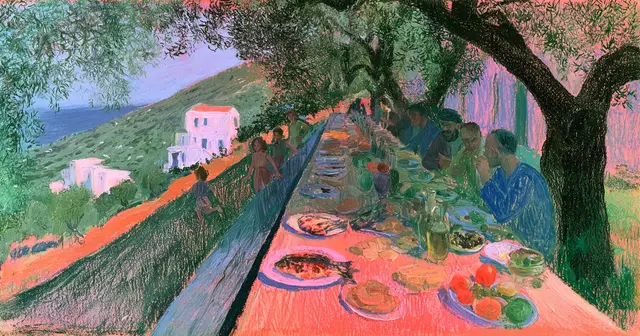
We used to live really well
I like mixing different types of water. Sparkling water, regular water, a bunch of them in one glass. It is a simple thing, but it gives the impression that you are making something. It adds a little effort to something as easy as water, and that makes it kind of delicious. You know the effect you get when you cook your own meal? It tastes ten times better because you are the one who cooked it. If someone else cooked the exact same thing for me, I think mine would still be better to eat, because I put the effort in. Enough of water. I will come back to it.
The thing I want to talk about is something I read in Sapiens a while ago. I am reading Homo Deus now, by the same author, and it came back to me. That part did not stay with me the first time. This time it did, and I spent a few days reading around it. I am not a historian. What follows is what I found, with the sources in the notes so you can check me.
The argument
Harari's claim is that the foragers, the people who hunted and gathered before farming, lived better in many ways than the farmers who came after them. They ate a wider range of food, they moved all day, and they worked less. He writes that even foragers living today in a place as harsh as the Kalahari work thirty-five to forty-five hours a week.1 The farmer got one crop, one field and a longer day. Harari calls the Agricultural Revolution history's biggest fraud, and one line from that chapter stuck with me:
We did not domesticate wheat. It domesticated us.2
The idea is older than his book. Jared Diamond called farming the worst mistake in the history of the human race back in 1987, and before him the anthropologist Marshall Sahlins described foragers as the original affluent society.3 There is physical evidence behind it too. A review of skeletons from around the world found that in most of the studies people got shorter as farming took over.4
It is also contested. How many hours a forager works depends on what you count as work, and the lowest numbers leave out cooking, making tools and looking after the camp.5 So I hold the claim loosely. But it left me with a question I liked. If farmers were worse off than foragers in some ways, then history did not simply improve. Progress is not one line going up: some things got better and some got worse, and I wanted to know which.
Think of a board with rows. Each row is one part of life: safety, medicine, food, the body, sleep, time. For each row I wanted to know which time and place did it best, for the average person and not for a king. I expected today to win most of them. It does not win all of them.
Safety
This row goes to today.
In small societies without a state, violence killed a lot of people, though how many is argued about. One well-known estimate, from the economist Samuel Bowles, puts deaths from warfare at about 14 percent in his sample of hunter-gatherer groups.6 Other researchers think that figure is too high. They say the sample was not representative, that some of the groups in it had already been disturbed by contact with outsiders, and that war itself was rare among small mobile bands. So the number is disputed, and the levels clearly differed a lot from one society to the next. What I take from the debate is that it is mostly about how much.
Harari gives the modern numbers in Homo Deus. In 2012 about 56 million people died in the world. Around 620,000 of them were killed by other humans, in war or in crime. That is about one in a hundred. In the same year 800,000 people took their own lives and 1.5 million died of diabetes.
Sugar is now more dangerous than gunpowder.7
So the danger moved. We are much less likely to be killed by a stranger and more likely to be hurt by how we live. I still take the trade. A person dropped here from almost any earlier century would notice the safety before anything else.
The trade has a price. Safety at this scale needs states, laws and millions of strangers cooperating, and that is exactly the large settled world the foragers did not have. I do not think you can keep the small band and the safe street at the same time.
Medicine
For most of history, in the hunter-gatherer and historical societies we have numbers for, about a quarter of babies died before their first birthday and about half of all children died before they grew up.8 Today fewer than four in a hundred die before the age of five.9 If I had to pick the single best fact about being alive now, it would be that one. Medicine goes to today as well.
I had the history of this wrong in my head. I thought medicine more or less began around the year 1000, in the golden age of science in the Islamic world. That period did matter.
Al-Razi described the difference between smallpox and measles, Ibn Sina finished his Canon of Medicine in 1025 and it was taught for centuries, and cities like Baghdad and Cairo ran large hospitals. But medicine is much older than that, and the big turn came much later.
The Black Death shows how late. It reached Europe in 1347 and killed tens of millions of people within a few years. In October 1348 the king of France asked the medical faculty of Paris what was causing it. The best doctors of the time answered that a conjunction of planets had corrupted the air.10 They could not have known better. The bacterium was only identified in 1894, five and a half centuries later.11 Germ theory dates from the 1860s to the 1880s and penicillin from 1928. Much of what keeps us alive is less than two hundred years old.
Imagine COVID with no idea what a germ is.
The worst thing I read while looking into this is what happened after 1492. When Europeans reached the Americas, they brought smallpox, measles and influenza to people who had never met them. One recent study estimates that about 56 million people had died by 1600, around nine in ten of the people living there, from those diseases together with the war, slavery and famine that came with the conquest. That is a high estimate and others are lower. All of them are terrible.12
Food
Here today starts to lose, at least in my reading.
We have more food than any people before us. But the everyday diet I found best described belongs to the Mediterranean around the 1950s, and to Crete in particular. In 1948 the Rockefeller Foundation sent a team to study the island. They found people living on olives, grains, beans, fruit, wild greens and herbs, with a little goat meat, milk, game and fish, and bread at every meal. Olive oil gave them a large part of their calories.13 Ten years later Ancel Keys began the Seven Countries Study, which found far less heart disease in Greece and southern Italy than in northern Europe or the United States.14
The other half of that report matters. Crete in 1948 was poor and had just come out of a war. Only one family in six told the researchers their diet was satisfactory, and what they wanted was more meat. The food we now praise was partly what was left when you could not afford anything else. So the row is won by a way of eating, not by an easy life.
Two things about it stay with me. The first is how basic it is. Whole food, a lot of variety, almost nothing processed, and people who know how to cook. If you have eaten in the south of France, in Spain or in Italy, you know what I mean. You can buy the same ingredients and try the same dish at home, and it will not taste like it does there. I still do not know why.
The second is the table. When UNESCO put the Mediterranean diet on its heritage list, it described more than a menu. It says that eating together is the foundation of the cultural identity of communities around the Mediterranean.15 Morocco, where I live, is one of the seven countries on that listing. One long table outside, everyone side by side. I cannot explain how much I like that picture.
The body
This row goes to the foragers.
The Hadza of Tanzania still hunt and gather, and researchers have followed them with GPS units and activity trackers. Depending on the study, Hadza adults take somewhere between eleven and eighteen thousand steps a day, and they get more than two hours of moderate or hard physical activity daily.16 Nobody there calls it exercise. It is how they get food.
Reading that, I thought about the gym. I train and I am glad I do. But there is something a little fake about it. We lift and run with no output except feeling good afterwards. They got the strength we are all chasing as a side effect of doing things that had to be done. Hunt for ten years and you become strong without ever thinking about being strong.
It is the water again. Effort that makes something feels better than effort for its own sake. I think I should cut more wood.
The same people who were this strong could die from an infected cut. That is why this row and the medicine row have to be read together.
Sleep
This is the row where I was wrong, and the real answer is more interesting than what I believed.
I thought people before electricity slept with the sun. Down at sunset, up at sunrise, long nights. In 2015 a team measured the sleep of three groups who live without electric light: the Hadza in Tanzania, the San in Namibia and the Tsimane in Bolivia. They slept between 5.7 and 7.1 hours a night, which is no more than we do. They did not go to bed at sunset. They stayed up a little over three hours after dark, and they usually woke before sunrise.17
So they do not sleep more than us. What they have is regular sleep and very little trouble with it. Their sleep closely followed the fall in temperature at night, and they woke at about the same time every day. Only around 2 percent said they had trouble sleeping more than once a year. In industrial countries, 10 to 30 percent of people report chronic insomnia. The researchers reported that the San and the Tsimane have no word for it.18
What I take from this row is smaller than I expected: keep a regular hour, and sleep somewhere cool. And I am glad the sunset idea was wrong, because a lot of life happens at night. Imagine being invited to dinner and saying, sorry, the sun went down.
Time
The last row is free time. It goes to the foragers, with the same caution as before about how hours are counted.
The best recent evidence I found comes from the Agta in the Philippines. Some Agta still forage and others have moved into farming, so researchers could compare the two ways of living inside the same people. The Agta who farmed worked about thirty hours a week outside the camp. The ones who foraged worked about twenty. For women the gap was bigger: in the farming camps they had half the free time.19
Why would foragers stop there? My guess, and it is close to what Sahlins argued, is the word enough. They carried what they owned, so owning more was a burden. If they needed something they made it or traded for it. When they had enough they stopped, and what they got in return was time.
Harari has a line for what happened next:
One of history's few iron laws is that luxuries tend to become necessities and to spawn new obligations.20
I see that law in my own life more than I would like. Something arrives as a convenience, and within a few years I cannot picture a day without it. Ask anyone how they spent an evening before the smartphone, or how they wrote an email five years ago without AI. I have nothing against either. But the question is hard to answer. Psychologists call this the hedonic treadmill: we adapt to what we have, and what was new becomes normal.21 I think it is one of our best skills and one of our worst.
What the board hides
A board like this can mislead.
It is built on averages, and the average forager in these studies is a survivor. Half the children are missing from the picture. The foragers we can measure today are not people from the past either. They live now, often on land nobody else wanted, next to states and markets. And I chose the rows. Someone else would add freedom, or knowledge, or how women lived, and those rows could come out very differently.
The bigger problem is that the rows were never separate. Cretans ate that way partly because they were poor. Foragers were that strong because nothing was delivered. Each win came attached to its cost.
That is also the good news. For most of history you took the whole package of your time and place. Maybe, for the first time, a person can take it apart a little. I can cook like Crete in the fifties with antibiotics in the cupboard. I can walk like a forager and still see a doctor.
One from here, one from there
So the question I ended up with is small and practical. I keep what today does best, the safety and the medicine, and I take back one thing from each row we lost. I want to cook real food and eat it with people, at a long table when I can. I want to move because something needs doing, and go to bed at the same hour. I want to decide what enough is for me, and stop there. Maybe I will take some Mediterranean cooking lessons.
None of it means going to live in a forest, and there are surely people who already live this way.
We used to live really well. Not in everything, and not for everyone, and I would not go back. But a lot of what we lost was never taken from us. It just became normal to live without it, and I only noticed when I read about it in a book.
Footnotes
-
Sapiens, chapter 3, A Day in the Life of Adam and Eve. ↩
-
Sapiens, chapter 5, History's Biggest Fraud. ↩
-
Jared Diamond, "The Worst Mistake in the History of the Human Race", Discover, May 1987. Marshall Sahlins, Stone Age Economics, 1972. ↩
-
Mummert and colleagues, "Stature and robusticity during the agricultural transition", Economics and Human Biology, 2011. Most of the studies they reviewed found the drop in height, not all. ↩
-
Richard Lee first counted twelve to nineteen hours a week of getting food among the Ju/'hoansi of the Kalahari. Counting cooking, tool making and housework, his total came to more than forty. ↩
-
Samuel Bowles, "Did warfare among ancestral hunter-gatherers affect the evolution of human social behaviors?", Science, 2009. The main criticism is Douglas Fry and Patrik Söderberg, Science, 2013. ↩
-
Homo Deus, chapter 1, The New Human Agenda. The numbers above are his. ↩
-
Anthony Volk and Jeremy Atkinson, "Infant and child death in the human environment of evolutionary adaptation", Evolution and Human Behavior, 2013. ↩
-
The UN estimates 37 deaths before the age of five for every 1,000 births in 2022. ↩
-
The report of the Paris medical faculty, October 1348, written for Philip VI. ↩
-
By Alexandre Yersin, during an outbreak in Hong Kong. ↩
-
Koch, Brierley, Maslin and Lewis, "Earth system impacts of the European arrival and Great Dying in the Americas after 1492", Quaternary Science Reviews, 2019. ↩
-
Leland Allbaugh, Crete: A Case Study of an Underdeveloped Area, 1953. Fat was about 38 percent of daily calories, most of it olive oil. The one family in six is from the same report. ↩
-
Ancel Keys, Seven Countries: A Multivariate Analysis of Death and Coronary Heart Disease, 1980. The fieldwork began in 1958. It is an observational study, and its conclusions about fat have been criticised since. ↩
-
UNESCO, Representative List of the Intangible Cultural Heritage of Humanity, "Mediterranean diet". First listed in 2010 with four countries, Morocco among them, and extended to seven in 2013. ↩
-
Brian Wood and colleagues, "Gendered movement ecology and landscape use in Hadza hunter-gatherers", Nature Human Behaviour, 2021, measured about 18,500 steps a day for men and 10,900 for women. The activity figure is from David Raichlen and colleagues, "Physical activity patterns and biomarkers of cardiovascular disease risk in hunter-gatherers", American Journal of Human Biology, 2017. ↩
-
Gandhi Yetish and colleagues, "Natural sleep and its seasonal variations in three pre-industrial societies", Current Biology, 2015. ↩
-
The insomnia figures, and the point about the missing word, come from the researchers' interviews as reported in the press when the study came out. The two numbers were not measured the same way, so the gap is a rough one. ↩
-
Mark Dyble and colleagues, "Engagement in agricultural work is associated with reduced leisure time among Agta hunter-gatherers", Nature Human Behaviour, 2019. The hours come from daytime observations and count work outside the camp only. ↩
-
Sapiens, chapter 5. ↩
-
Philip Brickman and Donald Campbell, "Hedonic relativism and planning the good society", in Adaptation-Level Theory, 1971. ↩