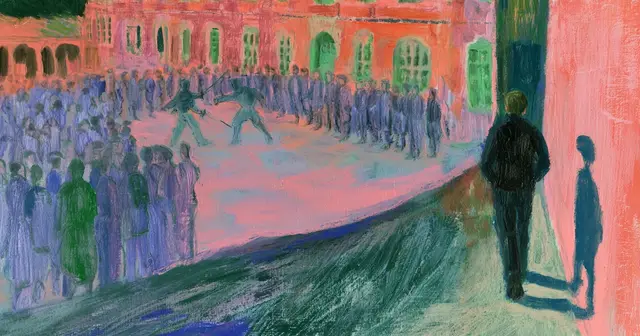
The Eminence in Shadow
I have watched this anime more times than I can count. The first time was about two years ago, and since then it comes back on rotation every six months or so. Almost no other anime does that for me.
It usually gets filed under comedy, or parody. The first time I watched it, I did not get it. The second time either. What I liked back then was the obvious part: the girls around the hero, and his strength, the OP character who wins every fight without trying, the same setup as One Punch Man.1 It took a few more viewings to understand what I actually like, and it has nothing to do with that. Take away the girls and the setup and keep only Cid, the main character, and what is left is an unusual way of thinking.
These days I skip most of the generic scenes and go straight to the ones where Cid is talking to himself.
What it is about
A boy in modern Japan has one dream. He does not want to be the hero, and he does not want to be the villain. He wants to be the eminence in shadow: the one who looks like a nobody and secretly runs everything from behind. He trains for it obsessively, gets hit by a truck, and is reborn in a fantasy world as Cid Kagenou, the son of a minor noble. The genre has a name, isekai.2
There he plays an average student by day, and by night he builds a secret organisation, Shadow Garden, to fight an evil cult that he completely made up. The joke the show runs on is that the cult turns out to be real. His followers know it. He never finds out, and he thinks everyone is simply playing along with his story.
It began in 2018 as a web novel by Daisuke Aizawa, and later became a light novel series, illustrated by Tōzai, and a manga. The anime is by the studio Nexus, directed by Kazuya Nakanishi. Season one is twenty episodes, from October 2022, and season two is twelve more, from October 2023. Together they cover the first four volumes of the light novel, so the story continues in the books, and a film is in the making for 2027.3
Believing in something
The idea I feel closest to in this show is simple: believe in something. Cid says that most people give up their childhood dream at some point, and he never did. He intends to keep building on it until he dies, and in his case even dying did not stop him. Everything in the story turns around that dream, and most of the comedy does too.
What I like most is how silly the dream is, and how seriously he takes it. In his first life he trains until he hits a wall: no amount of training lets a human survive a nuclear bomb. So he goes looking for magic. In the new world he finds it, and his signature move is called I Am Atomic. I understand him completely. It is an idealistic way to live, but that is what a story is for. You watch someone do what you probably cannot, or you ask what would happen if somebody really did it. Cid is that somebody.
His tastes are strange too. He loves roleplay, LARPing, being someone he is not. In his own words he wants to be a background character, an NPC.4 He wants to be strong and to have real control over things, and he wants nobody to know it is him. He would like the world to underestimate him while it runs on his decisions.
He lives like someone who keeps inventing scenes and then acting them out, in real time, in the real world. At one point he convinces himself that a princess has killed her father to take the throne and become a tyrant queen, and he is delighted, because it gives him a part to play against her. He does not care much about the people around him. That is the part of him I would not copy.
What matters to him and what does not
Cid takes almost everything lightly and a few things with total seriousness. He says he has divided the world into two categories, the things that matter to him and the things that do not. His reason is the dream: time and effort are limited, and the dream would never happen if he spent them on everything. I think that is a good way to divide a life. He has no casual interests, and he would never pretend to like something in order to be liked.
The scene I remember best is with Alexia, the princess with silver hair. Everyone compares her swordsmanship to her older sister's, who is a natural talent. Hers is plain, all fundamentals, and people call it mediocre. Cid's own style is the same kind, fundamentals taken to the extreme. On the train home he tells her that he likes her swordsmanship. When she pushes him on it, his answer is that he does not like it when someone puts down something he likes.
He does not care about much, but he knows exactly what he likes, and when he talks about those things he is completely honest. To me that is what being truthful looks like.
It works the other way too. When his friends try to pull him into gambling, he is not tempted and he does not argue. He just says no. The show is full of small moments like that.
The comedy helps. His two friends are always struggling next to him, and it is funny every time.
The show is idealistic, of course: most things go his way even when they should not. But when they do not, he hardly minds. In the second season he runs a counterfeit money scheme under a fake name and ends up with a mountain of gold. Then the gold disappears, and all he asks is who took his money. He decides that a villain he already defeated must have stolen it, and he goes digging through the snow where they fought. It was his own people who took it. He never works that out.
Part of the reason I rewatch it is as a reminder. I do not want to be Cid, he is too extreme for that. But I want to care fully about the things I like and stop caring about the things I do not. Some things are not worth my attention at all.
Cid is the cartoon version of a book I have reread a few times, The Subtle Art of Not Giving a F*ck by Mark Manson. I do not agree with everything in it, but the part I keep is the one about choosing what to care about. I did not expect an anime and that book to say the same thing.
I have not read past the anime, and I am seriously thinking about buying the light novel to finish the story. Until then I will keep rewatching. I never get tired of it.
Footnotes
-
OP is short for overpowered: a character so strong that no fight is a real threat. ↩
-
Isekai is Japanese for "another world": the hero dies or is pulled out of ordinary life and starts again in a fantasy one. ↩
-
The Eminence in Shadow: Lost Echoes, announced for Japanese theaters in 2027. ↩
-
LARPing is live action role-playing, acting out a character in real life as if it were a game. An NPC is a non-player character, one of the background people in a video game that nobody controls. ↩